This extract is from our recent whitepaper, Building the Business Case for Connected Critical Care Devices & Solutions. Featuring insights from industry leaders at Smith & Nephew, Olympus, and S3 Connected Health, this whitepaper explores how medtech companies can plan, develop, and scale connected device and digital health strategies across in-hospital, in-clinic, and hospital-at-home settings.
Medtech companies are increasingly looking beyond the device itself to understand where broader value can be created across the care continuum. The opportunity now spans preoperative, perioperative, and postoperative phases, reaching hospital administrators, payers, clinicians, and patients. Connected medical devices and digital health solutions allow companies to differentiate in the market, tap into larger value pools, and use data more strategically to support clinical, operational, and financial outcomes.
The strategic rationale is clear, but healthcare providers are increasingly evaluating connected solutions based on how seamlessly they fit into existing workflows and digital ecosystems. The greatest value is created when devices automatically capture and transfer data into clinical records, eliminate manual documentation and transcription steps, and provide clinicians with actionable information without adding complexity to their daily routines.
When implemented effectively, connectivity can reduce administrative burden by automating routine reporting and documentation tasks, support clinical decision-making through timely access to device-generated data, and improve operational visibility across healthcare organizations. Connected ecosystems can help track equipment utilization, monitor inventory, manage maintenance requirements, and improve device availability, providing value to both clinicians and medical device companies. These operational efficiencies are often as important to providers as the clinical benefits themselves.
“Clinicians themselves are now demanding more from their devices. They want more than a device that just does A, B, and C. They want to know how the device is performing, whether they can use it differently or better, and whether they are leveraging the entire ecosystem well enough to improve patient care.”
Gautam Sampath, Sr. Director, Platform & Software Engineering, Olympus
In markets where traditional medical devices have become increasingly commoditized, competitive advantage has shifted beyond the device toward the ability to deliver value through data, services, interoperability, and connected ecosystems. As healthcare providers continue to invest in digital health, medtech companies are under growing pressure to ensure their products integrate with broader healthcare technology environments. Increasingly, the value of a connected critical care device depends not only on what the device does, but also on how effectively it fits into the wider care ecosystem.
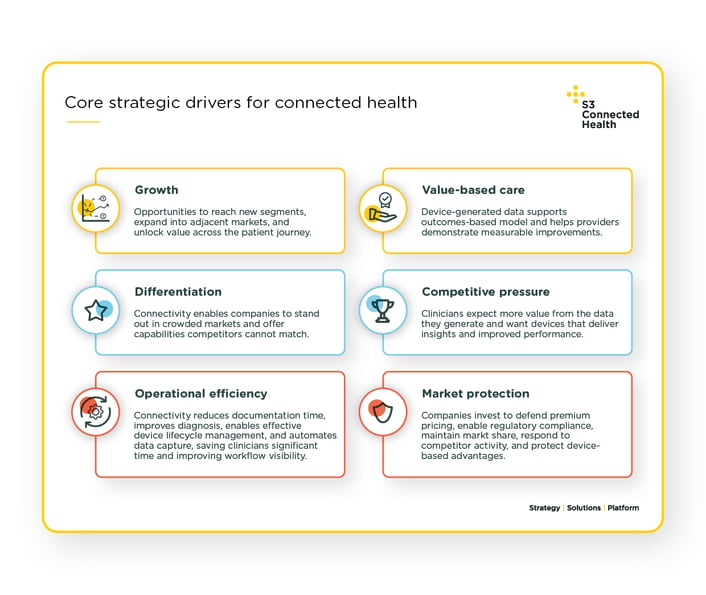
Companies increasingly invest in connectivity to defend existing market positions, maintain premium pricing, meet customer expectations, satisfy evolving regulatory requirements, and ensure their products remain compatible with emerging healthcare platforms. The defensive nature of many connected health investments reflects how rapidly the healthcare ecosystem is evolving. In many cases, connectivity is not pursued solely to create new revenue streams or disrupt the market.
Instead, companies are investing to protect existing business by maintaining interoperability with provider platforms, preserving access to key customer accounts, supporting regulatory compliance, reducing product support costs, and preventing competitive displacement. While growth and differentiation remain important objectives, many organizations view connectivity as a necessary capability for remaining relevant in increasingly digital healthcare environments.
“When it comes to the strategic drivers, what we are seeing is a primarily defensive approach. Sometimes they are dressed up as offensive, but when you talk in more detail, it is clear the core drivers are often coming from a defensive position.”
Piotr Sokolowski, Chief MedTech Strategist, S3 Connected Health
Some look to optimize parts of the product lifecycle, adding operational or customer-facing features that save costs or provide incremental value. And while new revenue streams from digital services are often discussed, most companies acknowledge they lack experience in selling these offerings effectively.
It is also important to recognize that pressures and drivers vary across the connected ecosystem for care. Early-stage device development may focus on differentiation and market positioning, while later stages emphasize operational efficiency, integration, and measurable outcomes. Funding for digital and connected solutions continues to grow, but reimbursement and return on investment remain challenging. Building a strong business case requires strategic thinking about how value is measured and realistic expectations about where ROI can be proven.
“The strategic drivers come from both external and internal forces: chronic disease trends, demographic pressures, workforce shortages, the shift in value from device to data, the ability to create holistic patient insights, and the financial imperative for medtech companies to expand into new revenue streams.”
Bill Betten, Director of Medtech Solutions, S3 Connected Health
Check out our recent whitepaper for more information on how medtech companies can build business cases that will allow them to plan, develop, and scale connected critical care and digital health strategies across in-hospital, in-clinic, and hospital-at-home settings.