%20(1)%20(1).png)
This excerpt is from our recent whitepaper, How Pharma Can Use Behavioral Science to Balance Global Strategy with Local Relevance, which discusses how pharma organizations build solutions that are globally scalable yet remain relevant across diverse healthcare systems, regulations, and patient populations. Featuring insights from experts from Astellas Pharma, Merz Therapeutics, Novartis, and S3 Connected Health, the whitepaper provides a structured framework for identifying the specific behavioral and environmental variables that justify adaptation, enabling more consistent, evidence-based decision-making across global organizations.
Traditional discussions about localization often focus on whether a market is different. Behavioral science provides a more useful perspective. Rather than treating markets as the unit of analysis, it examines the interaction between behavior and the environment in which that behavior occurs.
This creates a practical decision rule for determining when adaptation is genuinely required and when global consistency should be preserved.
This framework shifts discussions from opinion-based debates about whether a market is "different" to evidence-based debates about which specific variables differ. Rather than asking "Should we localize?", teams can ask "Which variable justifies adaptation?" This moves the conversation from "I think" to "show me the variable."
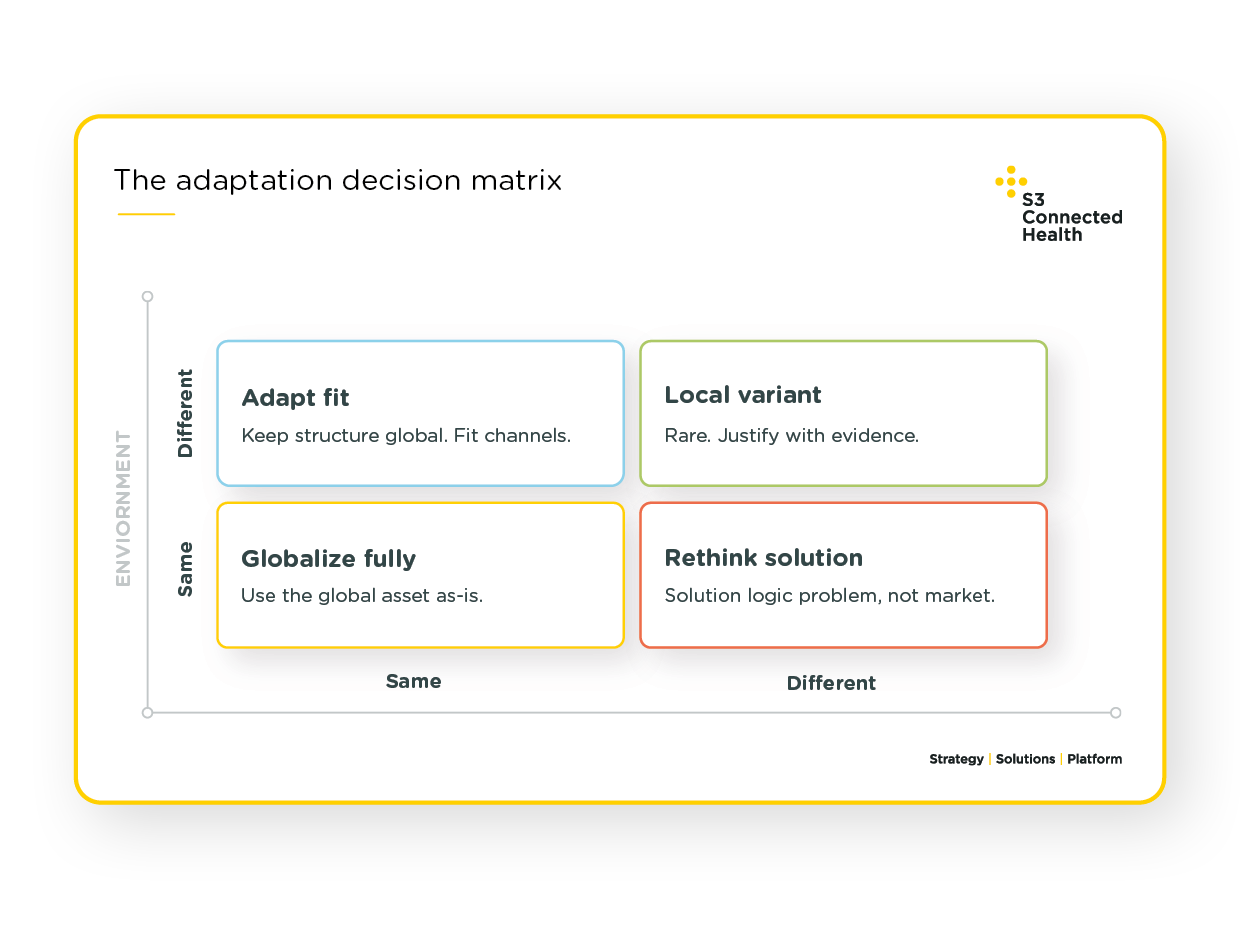 Behavior similar, environment similar: When both the behavioral challenge and environmental conditions are broadly consistent, the global solution can typically be implemented as designed. Extensive localization is therefore unlikely to create significant additional value.
Examples may include onboarding support, treatment initiation, or injection training programs where the behavioral challenge is consistent across markets and healthcare systems support similar implementation approaches.
Behavior similar, environment different: This is often where many global healthcare programs sit.
The underlying behavioral challenge remains consistent, but differences in healthcare systems, regulations, reimbursement pathways, clinical workflows, communication channels, or stakeholder roles influence how the solution must be delivered.
Messaging channels are a common example: the same adherence-support behavior may be delivered via LINE in Japan, WeChat in China, and WhatsApp in Brazil. The behavioral objective is identical; only the channel that fits the local environment changes.
The variation typically lies not in what the moment of friction is, but in how it must be addressed.
Behavior different, environment similar: When this occurs, organizations should resist the temptation to immediately localize an existing solution. Instead, they should revisit the underlying behavioral diagnosis.
A different behavioral challenge often suggests that the original solution logic may not be addressing the most important barrier in that context.
At this stage, organizations should return to the behavioral analysis and ask two critical questions to help determine whether a different intervention is required:
- Can we realistically make an impact on this problem?
- How significant is the problem, and for whom?
Behavior different, environment different: When both the behavioral challenge and environmental conditions differ significantly, a local variant may be justified.
However, this should be the exception rather than the default approach.
Organizations often assume they are operating in this quadrant when, in reality, many of the underlying behavioral barriers remain consistent across markets. Across global programs spanning multiple therapy areas and markets, roughly 70–80% of the behavioral moments of friction encountered are shared, with only a smaller proportion reflecting genuine local variation.
As a result, local variants should only be developed where there is clear evidence that both the behavioral challenge and the surrounding environment differ sufficiently to justify additional investment and complexity.
The goal is not complete standardization or unrestricted localization. The goal is disciplined adaptation: maintaining the scale, efficiency, and consistency of global strategy while enabling targeted flexibility where local variation genuinely improves outcomes.
If you haven’t already, you can access the full whitepaper for the complete insights HERE.
Hear from industry leaders at Astellas Pharma, Merz Therapeutics, Novartis, and S3 Connected Health, as they discuss how pharma organizations build solutions that are globally scalable while remaining relevant across different healthcare systems, regulations, and patient populations.